


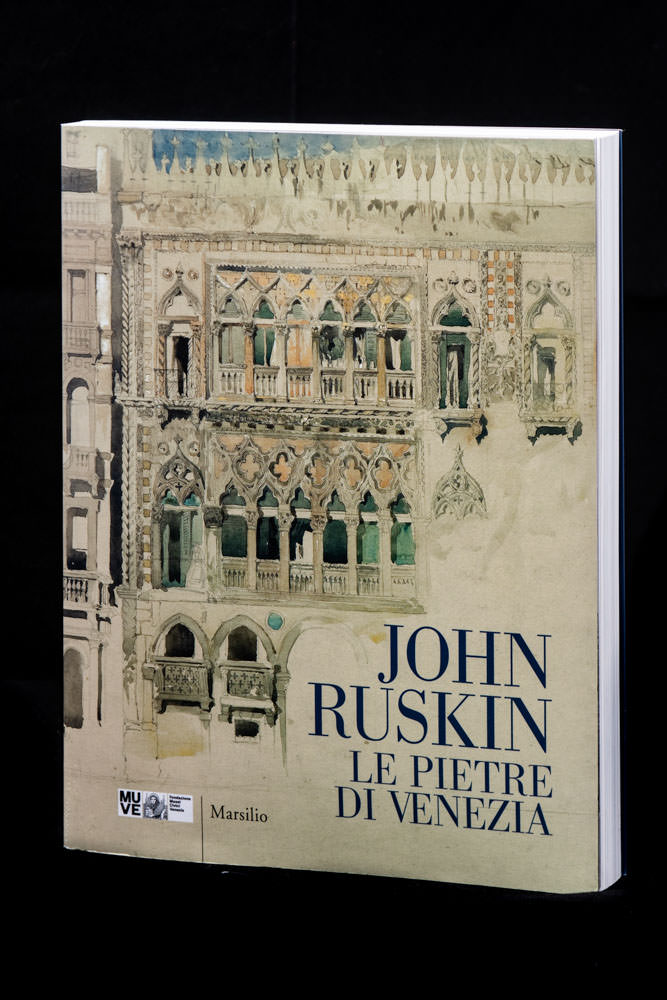
Description
John Ruskin. The stones of Venice edited by Anna Ottani Cavina, published by Marsilio is the catalog of the exhibition. It was held at Palazzo Ducale at the opening of the celebrations for the bicentenary of John Ruskin’s birth. It tells the story of the long and fruitful love affair between the famous English critic and the city of Venice.
John Ruskin visited Venice many times and published the work in three volumes entitled “The Stones of Venice”. A hymn to the beauty, uniqueness and fragility of this city. Venice, destined to become a cornerstone of Anglo-Saxon culture, is the beginning of the Gothic revival of the Romantic era.
The volume opens with a text by Gabriella Belli that tells the reasons for the exhibition. “An exhibition that focuses on the story of his personal artistic story. It is less known than the wider dissemination of his thought, contained in the thousands of pages written during his life and published in magnificent contemporary editions.
Follows the essay of the curator Anna Ottani Cavina John Ruskin. Portrait of an Artist. “This exhibition on John Ruskin, in the Gothic heart of the city, is meant to be a warning for the salvation of Venice. The exhibition is also a challenge to celebrate Ruskin as a painter, beyond his dizzying ability to play the many roles of genius. Beyond his own determination to privilege the written word.”
Joseph Rykwert’s talk, John Ruskin. An Ever-Living Voice, focuses on speeches given by Ruskin as part of numerous lectures, meetings, one of the main forms of popular entertainment in the nineteenth century.
To conclude the volume, the interventions of Sarah Quill, Sergio Perosa, Stephen Wildman, Francesca Tancini and Clive Wilmer, in addition to the catalog of the works in the exhibition, edited by Elena Marchetti, and the extensive bibliography of reference edited by Francesca Tancini.